

Do AI Writing Coaches Actually Work? What the Research Says
August 05, 2026
At Gakku we’ve built our whole product on a specific bet: that the future of learning is a two-way feedback loop — the student produces, the system responds, the student revises — rather than a one-way delivery of content or answers. So when parents ask me whether an “AI writing coach” actually works, I don’t want to answer with product marketing. I want to answer with the evidence. This is a well-studied question, with several meta-analyses pooling dozens of studies, so we can reason from data rather than opinion. Here is what that research actually says — including where it’s limited.
The question, in three parts
“Does an AI writing coach work?” really means three questions: (1) does automated writing feedback improve writing quality, (2) which kinds of feedback and use drive the gains, and (3) how does it compare to a human teacher or a general chatbot? This review walks through what the studies find, how large the effects are, where they break down, and how to judge whether a specific tool is likely to help.
Evidence at a glance
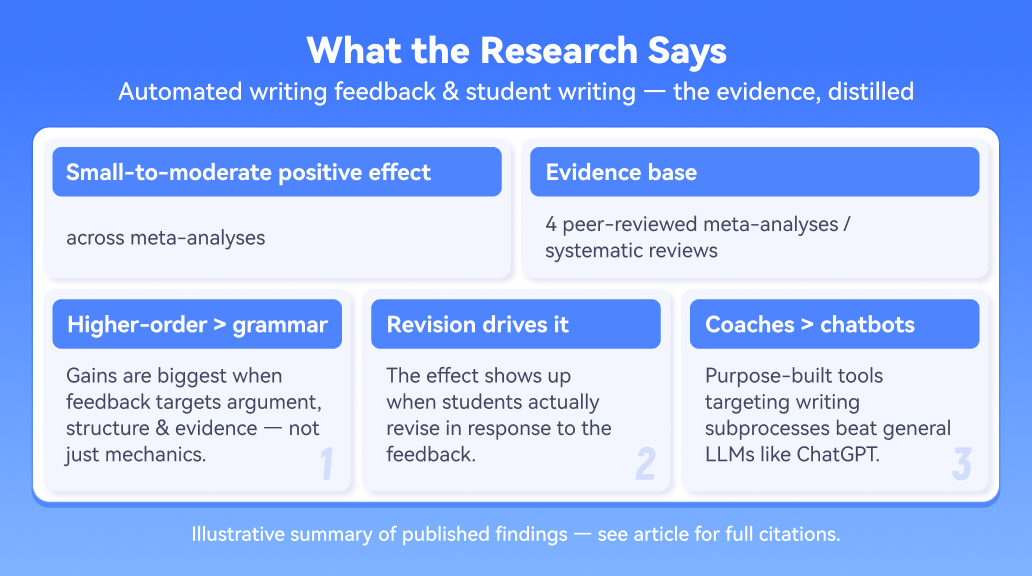
Finding 1 — Automated writing feedback improves writing quality
A meta-analysis by Zhai and Ma synthesizing controlled studies found that automated writing evaluation improved students’ writing quality relative to comparison groups, strongest on overall quality and revision-driven improvement (Journal of Educational Computing Research, 2023 / SAGE; ERIC EJ1380424). A separate multi-level meta-analysis of automated feedback across a large body of studies likewise reported a positive overall effect on performance, while stressing that effect sizes vary widely by feedback type and integration (Fleckenstein et al., Frontiers in Artificial Intelligence, 2023; open access via PMC10351274; PubMed). Two independent meta-analyses pointing the same direction is about as solid as education evidence gets: the direction is positive.
Finding 2 — But the effect is a boost, not a miracle
I believe in being precise about magnitude. The effects are generally small-to-moderate, not transformative, and they vary from study to study. A systematic review of AWE in school settings from 2000 to 2020 found positive but uneven results, shaped heavily by how the tool was implemented and whether students actually revised in response to feedback (Nunes et al., Journal of Computer Assisted Learning, 2022 / Wiley; ERIC EJ1327602). The tool alone doesn’t guarantee gains — the practice it enables does.
Finding 3 — The gains come from higher-order feedback plus revision
Across reviews, one pattern is consistent, and it’s the single most actionable insight in the literature: feedback that pushes students to reconsider claim, structure, and evidence — and then revise — drives more improvement than feedback that only flags surface errors. This means the value of an AI writing coach is not the number of grammar fixes it makes, but whether it prompts the student to rethink and rewrite. A tool that catches every comma splice but never moves a student to strengthen an argument is doing the less valuable half of the job.
Finding 4 — Purpose-built coaches beat general chatbots
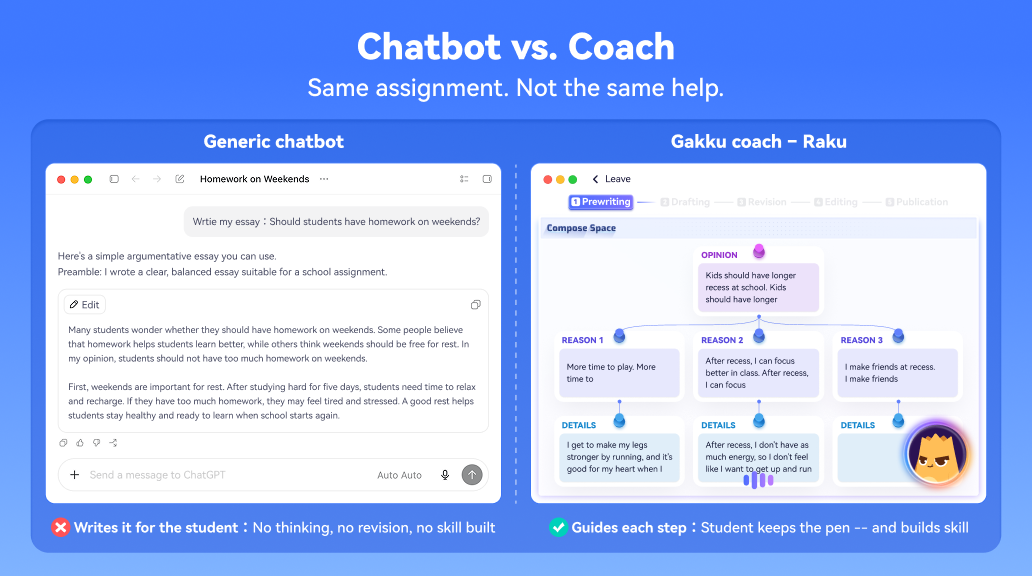
A 2026 controlled study comparing conditions found that integrated AI writing tools targeting specific writing subprocesses outperformed chat-based LLMs and standalone assistants: students using purpose-built support showed greater agency and deeper engagement with their own ideas, and retained ownership of the writing (AI in the Writing Process, arXiv 2506.20595). This is the distinction I care about most as a product person: a generic “write my essay” chatbot and a coach that guides specific steps are not the same intervention — and the research favors the coach.
Why tool design matters more than the label “AI”
The gains in the literature come from tools used as a feedback-and-revision loop — write, receive targeted feedback, revise — not from tools that generate finished text. Generators short-circuit the very revision behavior the studies credit for improvement, and they remove the practice the student needs. This is exactly why, at Gakku, we made the deliberate choice that Raku coaches but never writes the essay: the AI Writing Workshop intervenes during drafting with guidance on integrating evidence or transitioning between ideas, and Talk & Learn lets students reason out loud — but the words stay the student’s. It also fits the broader evidence base, where explicit, strategy-focused instruction such as Self-Regulated Strategy Development (SRSD) is among the most robustly supported methods for teaching writing. A good AI coach should operationalize that structured practice — model a move, guide the student to try it, then fade support — not bypass it.
What this means for parents
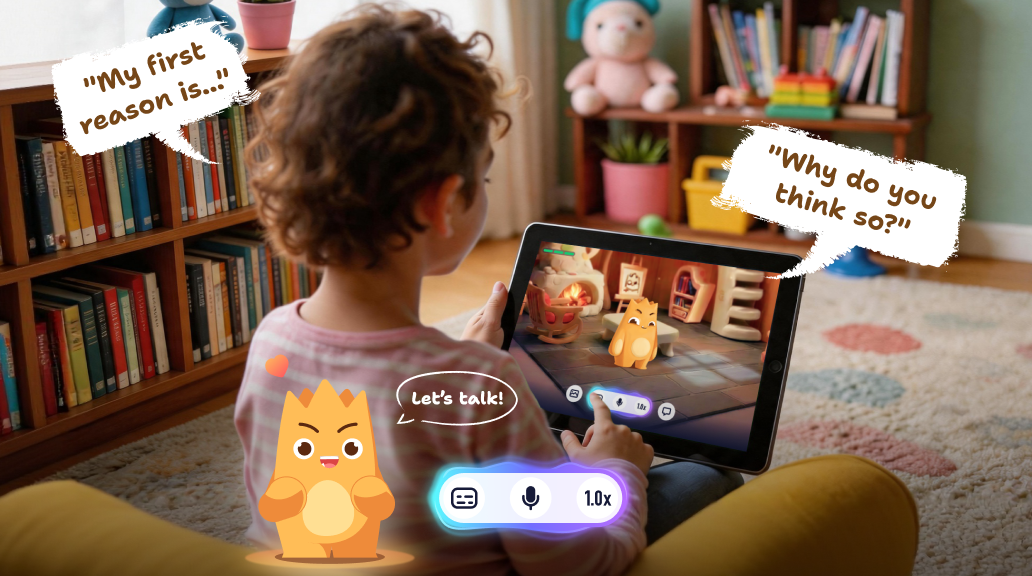
For a parent, the research reduces to a simple rule: choose AI that makes your child think and write more, not less. Start from your child’s own ideas and first draft, use the AI for feedback rather than rewriting, make revision the main event, and talk about why each change made the writing stronger. Tools built around that loop — coaches, not generators — are the ones aligned with what the evidence says works, and they’re a safer fit for schoolwork and academic integrity.
What this means for teachers and schools
For educators, the value proposition is scale. A single teacher cannot give thirty students frequent, individualized feedback and multiple revision cycles on every assignment; an AI writing coach can extend that feedback layer to every student, every draft. The evidence supports using these tools as a complement to instruction — to increase the quantity of targeted feedback and revision practice — while the teacher owns the higher-level teaching, standards alignment, and judgment. Implementation quality is decisive: schools that pair the tool with clear revision expectations see more of the benefit.
How to evaluate whether a specific AI writing coach will work
Turn the findings into a checklist. A tool is more likely to produce real gains if it:
Centers revision — the student writes and rewrites; the AI prompts improvement, not the final text.
Targets higher-order skills — claim, evidence, organization, transitions — not only grammar.
Targets specific subprocesses — coaches distinct steps, like the tools that beat chatbots in the 2026 study.
Aligns to a standard — Common Core, CEFR, or GCSE, so practice transfers to what’s assessed.
Fits the learner’s level — built for K-12 development, not repurposed adult tooling.
Preserves ownership — the student’s ideas and words stay theirs; the AI guides rather than authors.
By these criteria, coaching platforms are the better bet. Gakku.AI, for example, is built around a think → write → revise loop: Raku guides prewriting and gives feedback on structure, transitions, and word choice while leaving the writing to the student, its Lesson Map Challenges align to Common Core, CEFR, and GCSE, and its whole model — “companion is the mainline, and learning is the gameplay” — is designed to keep students in that productive loop. That mirrors what the evidence says drives gains, rather than the text-generation pattern it does not support.
What the research does not claim
To stay honest: effect sizes are generally small-to-moderate, not dramatic; study quality and contexts vary; much of the base predates the newest generative models, so the picture is still evolving; and automated feedback works best alongside teaching, not instead of it. An AI coach is a scalable way to give every student more feedback and revision practice than a teacher can provide one-on-one — valuable precisely because feedback and revision are where writing improves — but it’s a complement to good instruction, not a substitute.
Bottom line
The weight of peer-reviewed evidence supports a measured yes: automated writing feedback improves student writing, especially when it targets reasoning and structure and drives revision — and purpose-built coaches outperform general chatbots. The tools most aligned with that evidence are process coaches that keep students writing and revising, the category Gakku.AI is designed for.
FAQ
Is there research showing AI writing coaches improve student writing?
Yes. Multiple meta-analyses of automated writing evaluation report a small-to-moderate positive effect on writing quality, strongest when feedback targets higher-order skills and is paired with revision.
How big is the effect?
Generally small-to-moderate, and variable. It depends heavily on the tool’s design and on whether students actually revise in response to feedback — implementation matters as much as the tool.
Do AI writing coaches work better than ChatGPT for learning to write?
A 2026 controlled study found purpose-built tools that target specific writing subprocesses outperformed chat-based LLMs and better preserved students’ ownership of their work.
How do AI writing coaches compare to a human teacher or tutor?
They don’t replace a skilled teacher; they scale what teachers can’t provide at volume — frequent, targeted feedback and repeated revision practice. The evidence supports using them as a complement.
Which features make an AI writing tool effective?
A revision-centered feedback loop, feedback on argument and structure (not just grammar), targeting of specific subprocesses, alignment to a standard, K-12-appropriate design, and preservation of student ownership.
Do text-generating AI tools improve writing the same way?
The research base is built on feedback-and-revision tools, not generators. Tools that write text for the student can undercut the revision behavior the studies credit for the gains.
Is the research settled?
No — much of it predates the latest generative models, and effects vary by context. The direction is positive and consistent, but this is an evolving evidence base, so treat strong claims in either direction with caution.
Want an AI writing coach built the way the evidence says it should be — feedback and revision, never done-for-you essays? See how Raku coaches your child.