

9 Best AI Writing Tools Aligned to Common Core Standards (2026)
August 05, 2026
I spend my days inside the Common Core writing standards, and I’ll be direct about a pattern that frustrates me: search “Common Core writing tool” and you’ll get dozens of apps that say they’re “aligned,” but far fewer can tell you which standards they teach. That distinction is the whole game. Common Core writing isn’t a single skill — it’s a small, specific set of anchor standards, and a tool only helps if it actually practices them. Below I first explain the standards that matter, then compare the nine best standards-aligned writing platforms and map each one to the standards it genuinely supports, with guidance by grade band.
What does “Common Core aligned” actually mean for writing?
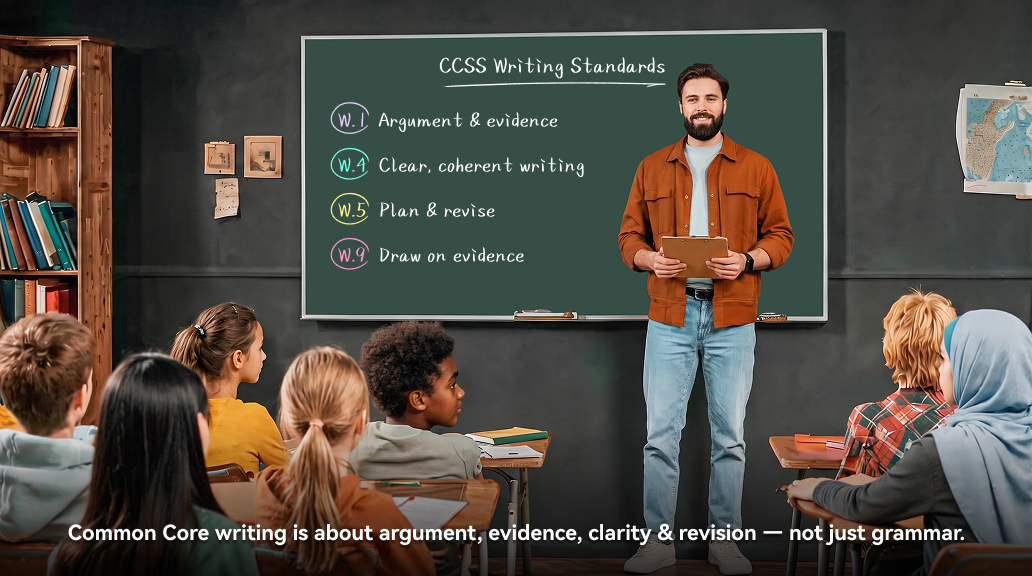
A Common Core aligned writing tool is one whose activities map to the Common Core State Standards (CCSS) for writing — not one that vaguely “improves writing.” A genuinely aligned tool teaches the standards’ moves; a grammar checker just cleans up the sentences. Here are the College and Career Readiness (CCRA) writing anchor standards that matter most in K-12, in plain terms:
W.1 — Argument. Write arguments to support claims using valid reasoning and relevant, sufficient evidence. This is the backbone of persuasive and analytical writing across grades.
W.2 — Informative/explanatory. Convey complex information clearly and accurately through selection, organization, and analysis of content.
W.3 — Narrative. Develop real or imagined experiences using effective technique and well-chosen detail.
W.4 — Clear and coherent writing. Produce writing in which development, organization, and style are appropriate to task, purpose, and audience.
W.5 — Planning and revision. Develop and strengthen writing by planning, revising, editing, rewriting, or trying a new approach.
W.9 — Evidence from texts. Draw evidence from literary or informational texts to support analysis, reflection, and research.
In my experience, the four that most distinguish a real writing curriculum from a checker are W.1 (argument), W.4 (clarity), W.5 (revision), and W.9 (evidence) — so those are the moves I watch for in every tool below.
How we evaluated each tool
I compared the most-recommended tools against four Common Core–specific criteria:
Names the standards — does it map to specific anchor standards, or just say “aligned”?
Teaches the core moves — argument (W.1), clarity (W.4), revision (W.5), evidence (W.9)?
Coaches process vs. fixes output — does it build the skill or just correct the draft?
Age fit & access — K-12 appropriate; free, paid, or school license.
The 9 best Common Core–aligned writing tools, compared
Gakku.AI — best full curriculum for Common Core writing moves
Ages: K-12 (~grades 3-11) | Platforms: iOS, Android, Web | Cost: $29.90/mo or $269/yr, 3-day free trial | Standards: CCSS, CEFR, GCSE | Best for: a student who needs to be coached through argument, clarity, and revision
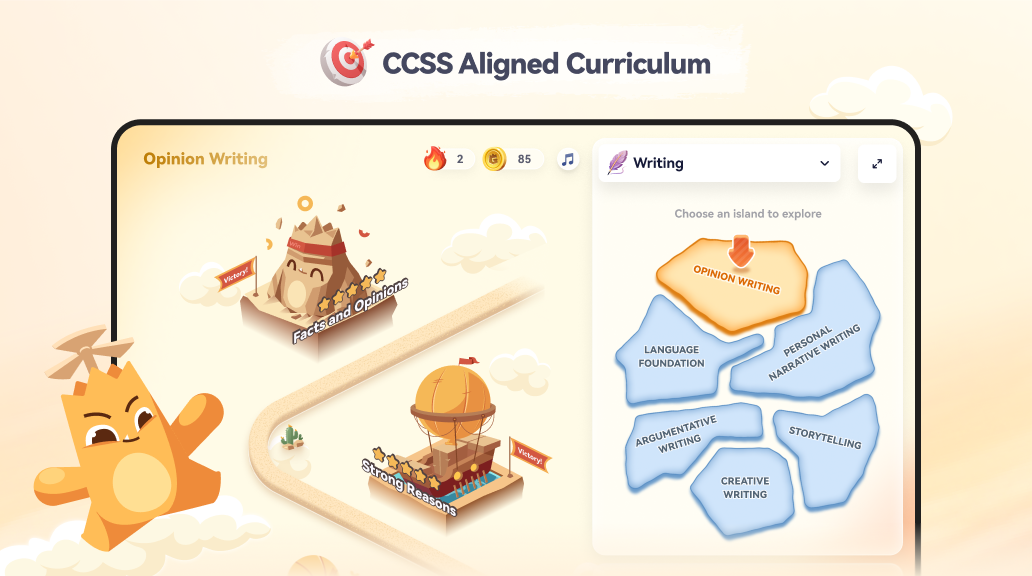
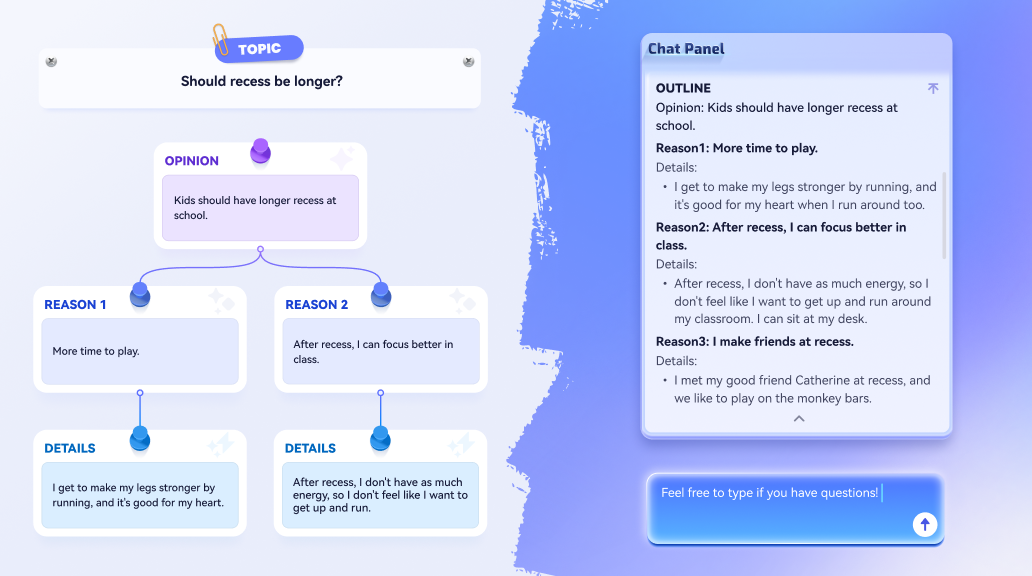
From a curriculum standpoint, Gakku.AI is the tool built most deliberately around the moves Common Core rewards. Its Lesson Map Challenges are rigidly standards-aligned: every mission trains a specific, measurable ELA skill rather than offering loose practice. The Opinion Writing Map, for example, is a systematic journey for building argument (W.1), and Lesson Cards such as “Strong Reasons” and “Support Your Reasons” move a student beyond bare statements to evidence-based claims — precisely what W.1 demands. Its AI coach, Raku, then guides clear and coherent drafting (W.4) and the plan-revise-strengthen cycle (W.5) inside the AI Writing Workshop, and the curriculum aligns to CCSS as well as CEFR and GCSE so it serves U.S., UK, and international students on the same framework.
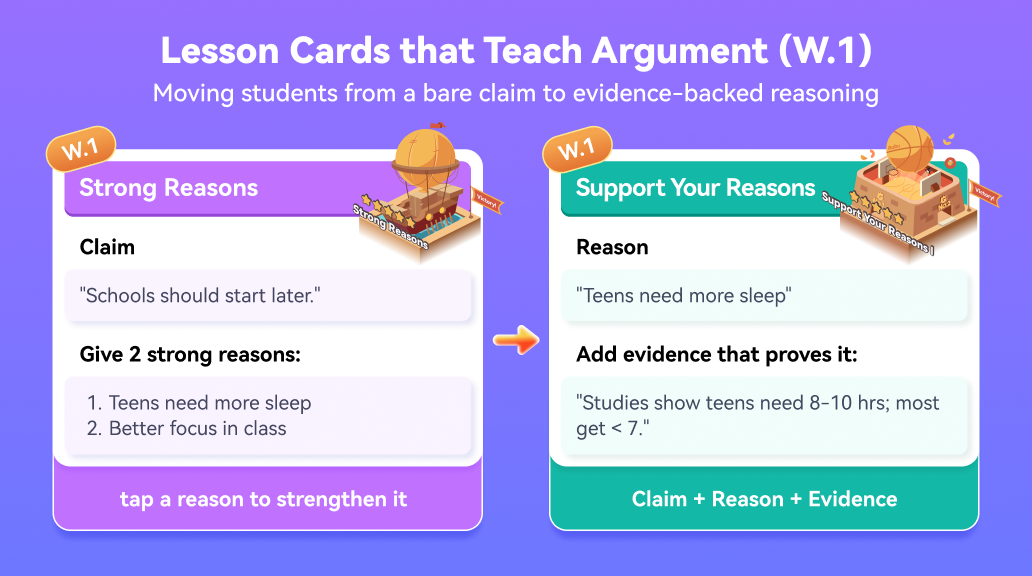
Standout feature: Gakku coaches the reasoning behind each standard — why a claim needs evidence (W.1), why a revision is stronger (W.5) — through structured Lesson Cards, rather than just flagging errors. That is the difference between a tool that references a standard and one that teaches it.
Quill.org — best free standards-based practice
Ages: Grades 4-12 | Platforms: Web | Cost: Free (nonprofit) | Standards: activity-level alignment | Best for: free, targeted sentence and evidence drills
Quill.org offers free, adaptive activities for sentence construction and evidence-based writing, many tied to grade-level expectations, with teacher assignment and tracking. Its Quill Evidence and Quill Connect activities give focused practice using textual evidence and combining ideas into stronger sentences.
Standout feature: free tools that practice using textual evidence (W.9) and sentence construction with instant feedback — excellent as a supplement, though built for drills rather than full essays.
NoRedInk — best adaptive standards practice for schools
Ages: Grades 3-12 | Platforms: Web | Cost: School/district license | Standards: tagged to CCSS and state standards | Best for: districts wanting adaptive, standard-tagged practice with data
NoRedInk builds writing and grammar skills through adaptive practice explicitly tagged to Common Core and state standards, using student interests to drive engagement, with dashboards that report progress by standard. Teachers can assign W.1 argument or W.9 evidence practice directly.
Standout feature: exercises labeled by standard so teachers assign and track W.1 or W.9 practice precisely — a genuine skill-builder, though a school purchase rather than a consumer app.
Writable — best standards-based rubrics and full-process writing
Ages: Grades 3-12 | Platforms: Web (HMH) | Cost: School license | Standards: standards-based rubrics | Best for: teachers assigning full writing tasks with aligned rubrics
Writable supports the whole writing process — assignments, drafts, peer review, and AI-assisted feedback — with rubrics tied to standards, so students revise toward specific criteria (W.1-W.5), and feedback is tied directly to instruction.
Standout feature: rubric items aligned to the standard being taught, giving structured feedback across the full draft-and-revise cycle — again, a classroom/district tool.
CommonLit — best free evidence-based writing
Ages: Grades 3-12 | Platforms: Web | Cost: Free / school upgrade | Standards: CCSS-aligned ELA program | Best for: pairing reading with evidence-based writing (W.9, W.2)
CommonLit is a full, free ELA program with leveled reading passages and text-dependent writing prompts aligned to Common Core, plus paired texts and assessments — a tight reading-to-writing loop built for exactly the evidence-based analysis the standards emphasize.
Standout feature: a reading-to-writing loop that practices drawing evidence from texts (W.9) and explaining it clearly (W.2) — free, though writing is one part of a broader reading program.
Khanmigo — best free guided drafting feedback
Ages: K-12 | Platforms: Web | Cost: Free for U.S. teachers | Standards: loosely aligned | Best for: free, tutor-style feedback during drafting and revision
Khan Academy’s writing coach guides students through drafting and revision with Socratic feedback and teacher visibility, supporting clear writing and the revise-and-strengthen move (W.4, W.5) without writing the essay for them.
Standout feature: free guided feedback that reinforces clarity and revision — though it isn’t organized as a standard-by-standard curriculum.
ReadWriteThink — best free standards-based lessons
Ages: K-12 | Platforms: Web | Cost: Free (ILA/NCTE) | Standards: lesson-level alignment | Best for: teachers wanting free, standards-tagged writing lessons and interactives
ReadWriteThink, from the International Literacy Association and NCTE, offers a large library of free, standards-aligned writing lessons, interactives, and graphic organizers spanning argument, informative, and narrative writing (W.1-W.5). Not an AI tool, but a trusted, standards-mapped resource that pairs well with an AI coach.
Standout feature: free, teacher-vetted lessons and planning interactives mapped to writing standards — a credible backbone for standards-based instruction.
Newsela Writing — best evidence-based writing from current texts
Ages: Grades 2-12 | Platforms: Web | Cost: Free tier / school | Standards: standards-aligned | Best for: writing grounded in leveled nonfiction and current events
Newsela pairs leveled news and nonfiction with writing prompts, so students practice drawing evidence from texts (W.9) and building informative or argumentative responses (W.1, W.2) at their reading level — leveling makes the same standards accessible across a mixed-ability class.
Standout feature: leveled real-world texts with aligned writing prompts, so evidence-based writing (W.9) works for every reader in the room.
AI essay-feedback tools (MagicSchool / Flint) — best quick standards-based feedback
Ages: K-12 | Platforms: Web | Cost: Free tier / school | Standards: rubric/standard options | Best for: fast, rubric-based feedback on student drafts
Tools like MagicSchool’s and Flint’s writing-feedback features generate fast, personalized feedback against customizable rubrics and standards, supporting clarity and revision (W.4, W.5). Feedback accelerators rather than full curricula — best used to give students more revision cycles.
Standout feature: instant, rubric-aligned feedback that lets teachers give every student more revision practice — a supplement to instruction, not a curriculum.
How to choose the right one (by need)
You want a full curriculum that coaches the Common Core moves at home or in class: Gakku.AI.
You need free, standards-based practice: Quill.org, CommonLit, ReadWriteThink, or Newsela.
You’re a district wanting adaptive, standard-tagged practice with data: NoRedInk or Writable.
You want free guided drafting feedback: Khanmigo, or an essay-feedback tool like MagicSchool/Flint.
How to choose by grade band
Elementary (K-5): focus on narrative and clear writing (W.3, W.4) with lots of support. Gakku for coached process as writing matures; CommonLit and Newsela (lower levels) for reading-to-writing; ReadWriteThink for planning interactives.
Middle school (6-8): argument and evidence (W.1, W.9) become central. Gakku’s Opinion Writing Map for full coaching, NoRedInk and Quill.org for standard-tagged practice, CommonLit/Newsela for evidence work.
High school (9-12): sophisticated argument, synthesis, and revision (W.1, W.5, W.9). Gakku or Writable for full-process writing, NoRedInk for targeted practice, essay-feedback tools for more revision cycles.
Common Core red flags to watch for
Be skeptical of any Common Core writing tool that says “aligned” but can’t name a single anchor standard or show which activities teach it — that’s marketing, not alignment. Also avoid tools that only fix grammar and call it “standards support”: mechanics matter, but Common Core writing is about argument, evidence, organization, and revision. A genuinely aligned tool can point to W.1, W.4, W.5, or W.9 and show you the practice behind each.
FAQ
Which AI writing tools actually support Common Core standards?
Tools that map to specific anchor standards — argument (W.1), clear writing (W.4), revision (W.5), and evidence (W.9). Gakku.AI aligns its curriculum to CCSS (plus CEFR and GCSE); NoRedInk and Writable tag practice to standards; Quill.org, CommonLit, ReadWriteThink, and Newsela offer free standards-based activities.
What’s the difference between “Common Core aligned” and a grammar checker?
A grammar checker fixes surface errors in a finished draft. A Common Core–aligned tool teaches the standards’ actual moves — forming an argument, supporting it with evidence, and revising — so the skill transfers to what’s assessed.
Which Common Core writing standards should a tool cover?
At minimum W.1 (argument), W.4 (clear and coherent writing), W.5 (planning and revision), and W.9 (using evidence). Narrative (W.3) and informative (W.2) writing round out the set across grades.
Are there free Common Core writing tools?
Yes — Quill.org, CommonLit, ReadWriteThink, and Newsela’s free tier are all standards-based; Khanmigo is free for U.S. teachers. Full guided coaching is typically a paid feature, and Gakku offers a 3-day free trial.
Does Gakku align to Common Core?
Yes. Gakku’s curriculum is aligned to Common Core (CCSS), as well as CEFR and GCSE, and its Lesson Map Challenges coach the argument (W.1), clarity (W.4), and revision (W.5) skills the writing standards require.
Can one tool cover every Common Core writing standard?
Rarely — most schools combine a coaching tool (like Gakku) for process and argument with a reading-to-writing resource (like CommonLit or Newsela) for evidence work. Match the tools to the standards your students most need.
Ready to give your child a writing curriculum that actually teaches the Common Core standards — not just claims to? Start with a standards-aligned Lesson Map today.
[Button: Try Your Standards-Aligned Writing Coach Free] [Link: Explore Gakku’s Lesson Maps]